



Why does my horse stamp its hind leg? Common causes and how to check for yourself
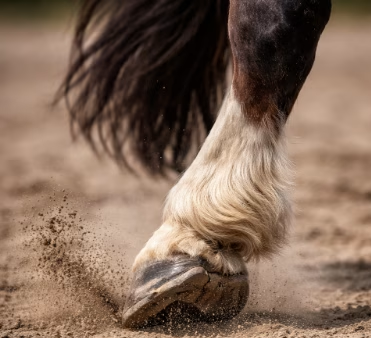
Have you ever noticed your horse suddenly stamping its hind leg – sometimes just once, and sometimes repeatedly? It can be quite a shock, especially if you can’t immediately see what’s causing it. The good news is that by observing calmly and carrying out a few quick checks, you can often quickly get a better idea of what might be going on.
Disclaimer: this blog provides general information only and does not constitute a diagnosis or treatment advice. If your pet has persistent, recurring or severe symptoms, it is advisable to consult your vet.
Stomping is often a sign: first look at the timing and the pattern
Before you start looking for causes, it helps to put the behaviour “into context” for a moment. Stomping can be a reaction to something minor (such as a fly), but also to itching, irritation or discomfort. That is why a pattern often provides more clarity than a single isolated observation.
To organise your thoughts, you could focus on:
- Situation: in the stable, in the field, whilst grooming, whilst riding
- Leg: always the same hind leg or alternating
- Frequency: occasionally or several times in a row
- Additional behaviours: rubbing, chewing on socks, restlessness when touched
- Conditions: warm weather, lots of insects, wet ground, mud
Here’s a tip that many owners find useful: record a short 20-second video once or twice a week. That way, you’ll be able to see more quickly whether anything changes.
Insects and biting insects: the most common “logical” reason
Many horses simply stamp their feet to shoo away flies, mosquitoes or small biting flies. You often see this in warmer weather, at dusk or in places where insects tend to gather.
Check for yourself:
- Can you see any insects around your legs or stomach?
- Does it help to use a fly rug, leg protection or some other insect-repellent routine?
- Is it mainly in one spot in the field or in a corner of the barn?
Practical tip: also check the stable hygiene and look out for damp patches. Manure and moisture attract insects, which means the problem is more likely to recur.
Itchy legs: socks, dandruff and irritation in the wallpaper
Kicking with the hind legs is very common when the lower legs are itchy. Horses wearing socks, in particular, can “hide” irritants in the fur, meaning you only notice them when you part the hair properly.
Check it yourself, calmly and systematically:
- Pull the socks right up to your skin and check for flaking, scabs or redness
- Feel for any tangles, clumps of mud or areas that seem sensitive
- Watch out for biting at socks, rubbing against edges or restlessness when stationary
Would you like to find out more about itching and how to recognise it better? Then take a look at this page: Skin condition: Itching
Moisture, mud and cavities: when the skin quickly becomes unbalanced
Wet meadows, mud and legs that remain damp for a long time can irritate the skin even more. You’ll often see chafing combined with scabs or rough patches in and around the pastern, particularly during wet spells.
Check for yourself:
- Are the knee cavities often wet or dirty?
- Can you see any cracks, scabs or irritated skin near the hock?
- Does it keep coming back after it has rained or after it has been hosed down?
A gentle approach that is often kind to both the skin and the horse:
- Let the mud dry first, then gently brush it off
- Only wash them when necessary and dry them thoroughly afterwards, including between the socks
- Do not pick at scabs
Mite sensitivity: itching that often first becomes apparent through behaviour
With legs prone to mites, itching is often the most prominent symptom. You usually notice this first through behaviour (stamping, biting, rubbing) and only later through visible patches. Particularly if there is a lot of dandruff, flakes and small scabs can become lodged deep within the fur.
Check for yourself:
- Does your horse mainly stamp its feet when it’s resting or in its stable?
- Is he biting at the socks, or does he not want you to touch his legs?
- Can you see flakes amongst the hairs, as if there were “dandruff” in the wallpaper?
Would you like to find out more about mites and how you can incorporate measures to combat them into your indoor and outdoor routine? Read more here: Mites in horses – supporting them from the inside and out.
Hoof and lower leg: a small stone, a lump of mud or something that’s got stuck
Sometimes stamping isn’t caused by itching, but by something irritating the hoof or the area around it. Think of a small stone, mud that’s stuck fast, or a slight edge that’s just a bit sensitive. In such cases, you’ll often see the horse lifting its hoof, putting it down, and stamping again.
Check for yourself:
- Scrape out the hooves and check carefully along the frog and the sole edge
- Check for any mud or small stones that may be stuck
- Observe their gait: do you notice any irregularity or defecation?
If you notice any obvious lameness, warmth, swelling or a severe pain response, please contact your vet.
Stimuli caused by equipment or circumstances: leg protectors, the stable, stress or habit
Not every instance of stamping is caused by the skin or the hoof. Some horses stamp due to friction (for example, from leg protectors), impatience (waiting time) or tension in a busy environment. That doesn’t make it any “less real”, but it does require a different approach: reducing stimuli and making the routine calmer.
Check for yourself:
- Does the stamping start as soon as you put the boots on, or whilst you’re fastening the girth?
- Does it mainly happen around feeding times or when there are stimuli in the stable?
- Does it go away if you change the situation (a different place, a different time, fewer stimuli)?
Tip: change one thing at a time, so you know what’s having an effect.
A quick 5-minute check: how to get an overview without overdoing it
Want to keep it practical? This often provides a quick answer:
- Watch for 30 seconds: when does he stamp his feet, and how often?
- Check your legs: the hollows of your shins, spread your socks apart, look for flaky skin and scabs
- Check the hooves: clean them out, remove stones, mud and any debris stuck in them
- Check for insects: particularly on the legs and along the abdomen
- Make a note of the pattern: which leg, what situation, what circumstances
Is the problem persisting, does it keep coming back, or can you tell that your horse is really suffering? If so, always consult your vet for an assessment.
Need help with a soothing routine for your legs and skin?
At Horse jitters We’d be happy to work with you to find a practical routine that suits your horse, his socks, the season and his stabling. Send us what you’ve observed (preferably with a short video or photos taken from the same angle) and we’ll help you work it out. If symptoms are persistent, recurring or severe, it is advisable to consult your vet.