



Skin irritation in horses: why skin sensitivity never just happens out of the blue
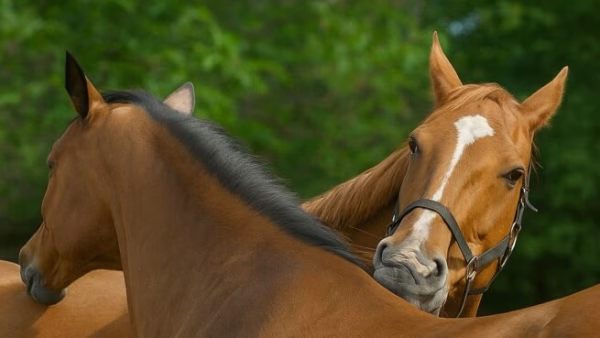
Itching and tickling in horses can sometimes seem like a minor issue.
A bit of rubbing, a bit of stamping, a moment of restlessness.
But if you look more closely, you’ll see that those tingles rarely occur on their own.
At Paardenkriebels, we see horses with recurring skin sensitivity on a daily basis.
Horses that suffer from this condition year after year.
Horses that seem to settle down for a while, but then the behaviour returns.
That’s no coincidence.
Nerves aren’t a problem in their own right
‘Butterflies’ is not a clearly defined condition.
It is a general term for skin that has become unbalanced.
This sensitivity may manifest itself as:
- Rubbing the mane or tail
- Kicking or biting at legs
- Flakes or a dull coat
- Irritated skin
- Restlessness or irritable behaviour
- One horse shows it quite clearly, the other more subtly.
- But almost always, the skin is sending out a signal.
Why jitters often keep coming back
Many horses suffer from restlessness not just once, but time and time again.
That’s because the cause often runs deeper than what you can see on the surface.
What we often come across:
skin that has lost its natural balance
repeated exposure to environmental or seasonal factors
insufficient support from within
care that provides temporary relief but does not offer long-term support
As soon as the visible symptoms subside, the treatment is often discontinued.
And that is precisely where the cycle of return begins.
Your skin reveals more than you might think
The skin is not a separate part of the horse.
It is a reflection of what is happening both internally and externally.
Sensitive skin may react to:
changes in the environment
prolonged strain
repetition of the same stimuli
lack of rest and recovery
It therefore stands to reason that simply washing or lubricating is rarely enough.
Why external care alone is often insufficient
External care is important.
Cleaning, grooming and protection are essential for horses with sensitive skin.
But when the skin is not adequately supported from within,
she continues to react in a vulnerable manner.
This is often reflected in:
temporary improvement
rapid relapse
having to make adjustments time and time again
It’s not a question of ‘applying it wrongly’,
but with limited support.
Indoors & outdoors: not a quick fix, but a balance
At Paardenkriebels, we therefore always take a broader view.
Not because we believe in quick fixes,
but because skin repair takes time and requires consistency.
A well-thought-out approach consists of:
external skincare, formulated for sensitive skin
support from within, tailored to the horse
Not as separate steps, but as a whole.
Not every itch is the same
Butterflies can manifest themselves in various ways.
The severity, location and frequency vary from horse to horse.
That is why standard advice is often not appropriate.
What one horse needs may be too much or too little for another.
That is precisely why we offer tailored care packages,
so that the support is tailored to the horse’s situation.
Why Paardenkriebels opts for peace and guidance
Paardenkriebels is not about making quick promises.
Not for ‘results within a few days’.
Not just one product as a solution.
We believe in:
-
look carefully
-
support rather than force
-
keeping the horse at the centre
This creates a space for rest, recovery and comfort.
In conclusion
Itching isn’t just a minor discomfort.
For the horse, they are often a sign that the skin needs support.
By not just looking at what is visible,
but also to what lies beyond,
you can choose an approach that suits the horse – both now and in the long term.
Paardenkriebels supports horses with sensitive skin
with care, knowledge and respect for the animal.